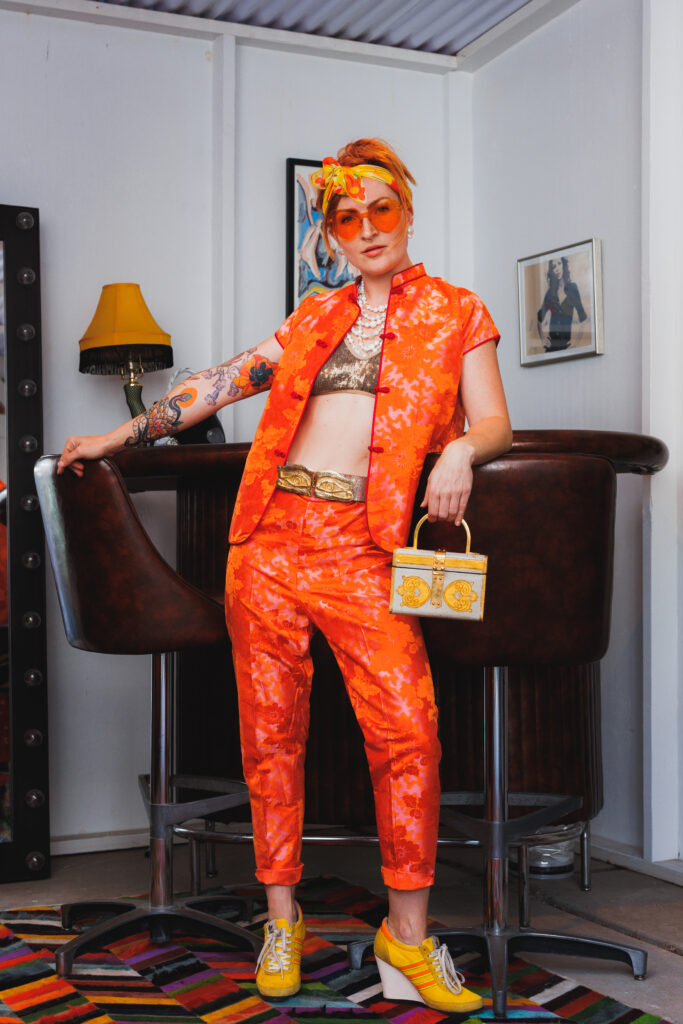
There’s a reason getting dressed in the morning can feel difficult especially on a hard day and a reason the right outfit can shift everything.
Most of us have experienced it: you’re running late, you throw on whatever’s clean, and somehow the whole day feels slightly off. Or the opposite, you wear something you love and find yourself standing with poise, speaking a little more freely, and low key feeling yourself!
This isn’t a coincidence. The relationship between what we wear and how we feel is well-documented in psychological research, and it runs deeper than vanity or fashion trends. Clothing intersects with mood, identity, self-perception, and even cognitive performance in ways that researchers are only beginning to fully understand.
In 2012, researchers Hajo Adam and Adam D. Galinsky introduced the term “enclothed cognition” to describe the systematic influence that clothes have on the wearer’s psychological processes. In their landmark study, participants who wore a white lab coat (told it belonged to a doctor) performed significantly better on attention tasks than those who wore the same coat described as a painter’s coat, or who simply looked at the coat without wearing it.
The conclusion? It’s not just about how clothes make us look. It’s about what they mean to us, and how wearing them causes us to embody those meanings.
This concept has real implications for everyday mental health. When we dress in a way that aligns with a role or identity we value, whether that’s “capable professional,” “creative person,” or “someone who takes care of themselves,” we psychologically step into that role more fully.
The connection between clothing and mood flows in both directions.
Clothes affect mood. Research by Professor Karen Pine at the University of Hertfordshire found that what women wore was closely linked to their emotional state. When feeling depressed, 57% of respondents said they tended to wear jeans, compared to just 33% on happy days. Wearing a favourite outfit was linked to elevated mood, while shapeless or dull clothing was associated with low self-esteem and low energy.
Mood affects clothing choices. When people are anxious or depressed, they often gravitate toward clothing that hides or minimizes, loose, dark, comfortable, and inconspicuous. This can create a feedback loop: feeling bad leads to dressing in a way that reinforces invisibility, which can deepen the feeling of being stuck or withdrawn.
Understanding this loop gives us a point of intervention. Intentionally choosing clothing that feels uplifting (even on low-energy days) can act as a small but meaningful act of self-care. The way you think, affects the way you feel, affects the way you act- a big component of Cognitive Behavioral Therapy (CBT). It starts with what you think of what you you wear.
Clothing is one of the most immediate and visible forms of self-expression we have. Long before we speak, we communicate through what we wear- our values, our affiliations, our mood, our creativity.
Research in social psychology consistently shows that authenticity, the sense that our outer presentation matches our inner identity, is strongly tied to psychological wellbeing. When people feel able to dress in a way that reflects who they truly are, they report higher self-esteem, greater life satisfaction, and lower rates of anxiety.
This is especially significant for:
On the other hand, enforced dress codes (in schools, workplaces, or families) can suppress this self-expression and, in some contexts, negatively impact mental health and sense of self.
For many people, what to wear is a genuine source of anxiety. “Outfit anxiety” – the stress of choosing clothing, fear of judgment, or feeling that one’s body doesn’t look “right”- is remarkably common and can be a symptom of broader social anxiety or body image issues.
At the same time, clothing can be a tool for managing anxiety. Comfort dressing, soft fabrics, familiar cuts, and/or sensory-friendly materials, can have a regulating effect on the nervous system. This is particularly relevant for people with sensory processing differences, including many autistic individuals, for whom the physical sensation of clothing is directly tied to their ability to feel calm and focused.
There’s also the concept of “power dressing” – wearing clothing that makes you feel competent and authoritative, which has been shown in multiple studies to reduce cortisol (a stress hormone) and increase feelings of control in high-pressure situations.
One of the less-discussed but telling signs of depression is a withdrawal from personal presentation. People who once took care with their appearance may stop caring altogether. Getting dressed feels effortful, and the wardrobe, once a source of pleasure or identity, becomes neutral at best, a source of shame at worst.
Therapists who work with depression often note clothing as both a symptom to watch and a tool in recovery. Small acts of grooming and intentional dressing can serve as behavioral activation – a well-evidenced therapeutic technique in which small, manageable actions are used to build momentum and counteract the inertia of depression. Dressing for Dopamine!
This doesn’t mean “dress up to feel better” is a cure. But the act of putting on clothes that feel like you, that reflect care for yourself, can be a meaningful step, especially when larger ones feel impossible.
A growing number of clinicians and researchers are taking the clothes-mental health link seriously enough to build therapeutic frameworks around it.
Fashion therapy is an emerging practice that uses intentional clothing choices as a tool for building confidence, processing identity, and improving mood. Some therapists incorporate “wardrobe work” into treatment, helping clients identify clothing that feels empowering, understanding the stories behind items they keep but never wear, and clearing out pieces that reinforce negative self-perceptions.
Initiatives have also emerged for specific populations: programs that provide professional clothing to people re-entering the workforce after mental health crises, or that give individuals experiencing homelessness or poverty access to clothing that supports dignity and self-worth.
Understanding the clothes-mental health connection doesn’t require a wardrobe overhaul or a fashion budget. A few evidence-informed principles:
The clothes we wear are never just fabric! They’re a language, one we speak to the world and to ourselves simultaneously. When we choose them thoughtfully, they can reinforce a sense of identity, regulate mood, build confidence, and even support recovery from mental health challenges. When we ignore the connection, we miss a simple, accessible, and surprisingly powerful lever for wellbeing.
Clothing can be a powerful outlet, you are the artist, the paint, and the canvas, when it comes to getting dressed.
The next time getting dressed feels hard, it might be worth asking not just what to wear, but what you want to say, to the world, and to yourself.
How do I want to show up today, ask that of yourself and your clothes!
References available on request. Key studies include Adam & Galinsky (2012) on enclothed cognition; Pine (2014) on mood and clothing; and emerging work in fashion therapy